


A Multidimensional Framework for Understanding Fracture and Reconstruction
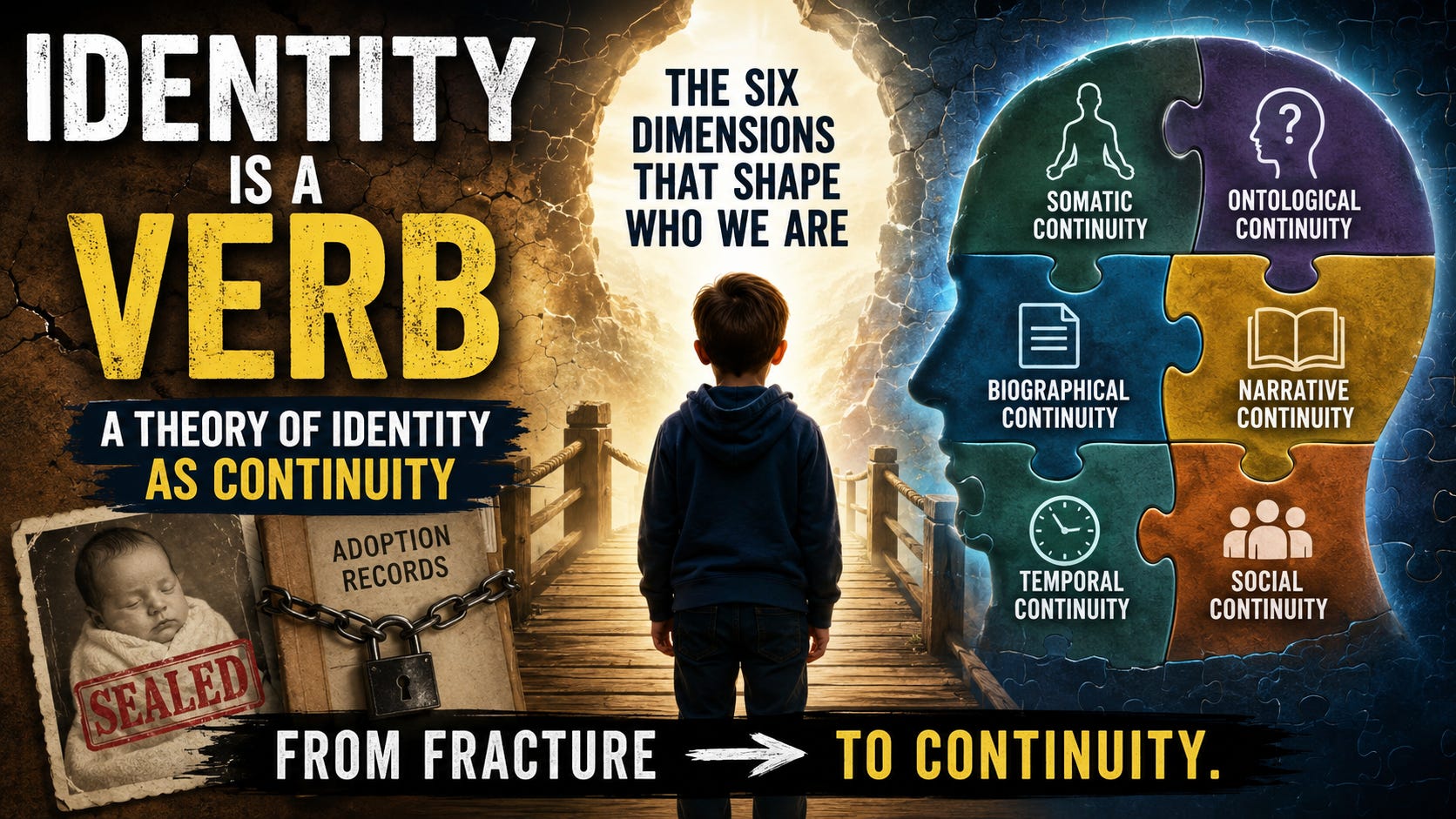
What does it mean to be the same person over time? For decades, mainstream psychology has encouraged us to view identity as a private possession—a collection of stable personality traits, a unique story we tell, or a set of internal “parts.” But for the person who discovers at age forty that their birth certificate is a state-authored fiction, these definitions offer little comfort. Such a discovery sends a “tremor” through the architecture of the self, vibrating through the body, memory, and the very capacity to imagine a future. In his transformative framework, Identity as Continuity, Shane Bouel proposes that we have been looking at the self through the wrong lens. Identity is not a static thing we “have”; it is a dynamic experience of continuity that we must actively sustain. When this continuity is fractured by external forces—be it through sealed records, forced displacement, or institutional secrecy—the self doesn’t just change; it undergoes a structural severance that requires a total reorganisation of being. Here are six lessons from this framework that reframe our understanding of the human self.
1. Identity is an Experience of Continuity, Not a Possession
The first axiom of Bouel’s framework is a philosophical pivot: identity is not a “possession” located inside the individual. Instead, identity is the ongoing experience of integrating our existence across time and context. This is more than a semantic nuance. It suggests that our sense of self is a “maintenance project.” We do not simply “exist”; we sustain our existence through a thread of continuity. When an external act—like a “clean break” adoption or a state-enforced removal—snaps that thread, the individual is forced into a fundamental reorganisation. The self is not lost, but the ground upon which it stood has been pulled away, making the “work” of being a person exponentially more difficult.
2. The Body “Keeps Score” Long Before the Mind Can Speak
Long before a child has the words to narrate their life, they possess what D.W. Winnicott called “going-on-being.” This is Somatic Continuity: the primordial, pre-reflective sense of inhabiting one’s own body. For many whose identities were fractured in infancy, the rupture is sensory. A baby separated from their birth mother loses a specific continuity of smell, touch, heartbeat, and voice. This is not merely a “memory” in the cognitive sense; it is an embodied disruption. As trauma expert Bessel van der Kolk famously noted, “the body keeps the score even when the mind cannot remember.”Because this somatic disruption occurs before language, it often cannot be reached by traditional “talk therapy.” This explains why many experience a persistent sense of “bodily alienation” or unexplained physiological distress. It is not a medical mystery; it is a nervous system registering a severance that the mind was never permitted to name.
3. The Dual Fault Lines of Western Psychology
Mainstream Western psychology has long operated with a “blind spot,” treating the individual as a self-contained unit. Bouel, drawing on the liberation psychology of Ignacio Martín-Baró and Frantz Fanon, argues that this creates two devastating “fault lines” in how we treat human suffering.
The Ontological Fault Line: When a person’s continuity is severed by the state, their resulting anxiety is often labelled as an internal disorder—like Borderline Personality or Reactive Attachment Disorder. This asks, “What is wrong with you?” rather than “What was done to your continuity?” Following Fanon, we must recognise that the “shattering of the self” is often an engineered outcome of institutional systems, not a private pathology.
The Epistemological Fault Line: This is the conflict over what counts as “truth.” Mainstream clinical and legal systems often privilege the record (the amended, fraudulent birth certificate) over the body (the somatic memory of separation). This creates a gaslighting effect where the state’s “legal fictions” are treated as more authoritative than a person’s lived, embodied experience.
4. You Are the Forensic Detective of Your Own Life
For most, building a life story is a natural developmental process. But for those whose continuity has been institutionally fractured, it becomes a forensic process. “Autobiographical reasoning” is not a dry cognitive task; it is a vital survival mechanism. The individual must act as a detective, evaluating fragments of testimony and DNA results just to establish a baseline of truth. This forensic work is necessitated by specific “fictions” that fracture the biography:
Altered birth certificates that replace biological reality with legal convenience.
Sealed records that treat a person’s own history as state property.
Fabricated family histories that leave the physical self unexplained.
Administrative lapses that allow oversight of the self to vanish.
5. Why a Locked Past Means a Blocked Future
Temporal Continuity is the ability to see one’s life as an unfolding story. However, when the past is legally unrecoverable, many experience “narrative foreclosure”—the sense that the story is effectively over. If you are prevented from knowing “who I was,” it becomes structurally impossible to ground the image of “who I will become.” Being stuck in an “eternal present of ambiguity” is not a personal failure of optimism; it is a structural closure of possibility. You cannot bridge the gap to a future when the bridge to your past has been demolished by a court order.
6. Recognition is a Political Act, Not Just a Social One
We all require “Social Continuity”—recognition from others to feel real. But Bouel adopts the “Coulthard critique” to warn that recognition can be a trap. When the state—the very entity that authored the original fracture—” grants” access to records, it often does so as a “technique of governance.”This “state-sanctioned misrecognition” manages a person’s grievance without actually relinquishing the power that caused the injury. Therefore, unsealing a record or restoring a name is not just a legal administrative act; it is a restorative act of identity. True repair requires that the institutions responsible for the misrecognition be held accountable for the structural power they wield over a person’s origins.
Conclusion: The Demand for Structural Accountability
The “Identity as Continuity” framework moves us beyond individual pathology and toward structural accountability. It suggests that the “tremor” felt by the adoptee, the refugee, or the survivor of mass atrocity is a rational, proportionate response to a documented act of severance. This leads to a radical demand for the clinical world: Mandatory Structural Rule-outs. A clinician should not be permitted to diagnose a “personality disorder” without first documenting whether a “structural severance”—such as a sealed record or forced removal—exists. We must stop coding a person’s search for truth as a “symptom” and start seeing it as the integrative process of a person trying to heal. Healing is not a matter of private resilience; it is a matter of restoring continuity. To achieve true existential security, our society must move away from the “legal fictions” that fracture lives and instead uphold every individual’s right to access the fragments of their own history and re-author their own story.
Identity as Continuity
A Multidimensional Framework for Understanding Fracture and Reconstruction
You do not have an identity. You sustain one.
That distinction is the entire argument of this framework — and the reason this app exists. Most models of the self treat identity as a possession: a set of traits, a story you tell, a personality you carry from room to room. Those models work reasonably well for people whose continuity was never interrupted. They fail, precisely and predictably, for anyone whose continuity was severed by an external act — a sealed adoption file, an amended birth certificate, a forced removal, a border, a diagnosis that arrived instead of an explanation.
Identity as Continuity reframes identity as something you do, not something you have: the ongoing, active maintenance of coherence across six interdependent dimensions of experience — Somatic, Ontological, Biographical, Narrative, Temporal, and Social. Each dimension has its own fracture points and its own repair mechanics. None of them is optional, and damage in one cascades into the others.
Adoption — closed, forced, or discovered late in life — is the paradigmatic case this app is built around, because it is one of the few circumstances where an institution executes a documented, dated act that fractures all six dimensions at once. But the framework does not stop at adoption. The same structural mechanism is visible in forced migration, institutionalisation, the Stolen Generations, genocide, and any context where a person’s continuity was overwritten by a record rather than lived by a body.
This app is the working, interactive home of that theory: the full framework, its clinical and institutional implications, and the case for treating structural severance — not personal pathology — as the correct diagnosis.
Status: v1, in active development.
🔗 Live app (v1, in development): identity-as-continui-j0ys.bolt.host


GitHub -
https://github.com/sbouel72/Identity-as-Continuity/
Full Framework Whitepaper
https://drive.google.com/drive/folders/1a9ddEcZtTDvRY16cIT-vk-17RWUYEAm3?usp=drive_link


