



There was a time when design was treated as decoration. A layer applied after the “real work” was finished. Then came the era of usability, where design became a servant of efficiency — smoothing friction, accelerating interaction, and optimizing human behavior for consumption. But the future of design is moving somewhere far more dangerous, and far more consequential.
Design is no longer about making things look beautiful.
It is about shaping cognition itself.
The interfaces surrounding modern life — phones, cities, algorithms, classrooms, hospitals, financial systems, borders, archives, even memory — are not passive tools. They are architectures of perception. They determine what people notice, what they ignore, what they remember, and ultimately what they believe to be real.
The designer of the future will not merely arrange pixels or objects.
They will shape epistemology.
YOUTUBE
From Usability to Cognitive Sovereignty
For decades, the dominant ideology of design worshipped seamlessness. The highest compliment a designer could receive was that the interface “disappeared.” No friction. No interruption. No pause between desire and fulfillment.
But seamlessness has consequences.
Infinite scroll. Autoplay. Predictive feeds. Algorithmic curation. Every frictionless interaction slowly retrains the nervous system to abandon reflection in favor of impulse. The human mind becomes conditioned for reaction rather than contemplation. Attention fragments. Memory weakens. Curiosity collapses into passive consumption.
The future of design will confront this directly.
The next generation of designers will increasingly recognize that friction is not always failure. Sometimes friction is ethics. Sometimes resistance is intelligence. Sometimes a pause is the last remaining defense against manipulation.
The future will belong to “seamful” systems — environments that reveal complexity instead of concealing it. Interfaces that expose the machinery beneath the surface. Systems that encourage deliberation rather than addiction. Technologies that treat users not as data-producing organisms, but as thinking beings capable of uncertainty, contradiction, and critical judgment.
The most important design question of the next century may no longer be:
“How do we make this easier?”
But instead:
“What kind of human consciousness does this create?”
AI and the Death of Reflection
Generative AI represents the greatest design rupture since the industrial revolution.
Not because machines can now generate images, text, or code — but because they threaten the reflective process through which human beings develop understanding in the first place.
Design has traditionally been a conversation between mind and material. A sketch changes the designer. A draft reveals hidden assumptions. Mistakes generate insight. Reflection emerges through resistance.
AI compresses that entire process into instantaneous output.
The danger is not merely automation. It is epistemic atrophy.
When systems produce polished answers before humans struggle with uncertainty, people slowly lose their tolerance for ambiguity, inquiry, and sustained thought. The future designer will therefore face a profound ethical challenge: whether to create systems that replace cognition or systems that deepen it.
The most valuable technologies of the future may not be those that think for us, but those that force us to think more rigorously ourselves.
This means future design must embed reflection directly into interfaces. AI systems will need to become transparent rather than mystical. They will need to expose reasoning pathways, uncertainty levels, biases, and limitations. Design will evolve from persuasion architecture into cognitive scaffolding.
The designer becomes less an illusionist and more a steward of human awareness.
The Political Future of Design
The myth of “neutral design” is collapsing.
Every interface distributes power. Every architecture privileges some bodies while excluding others. Every platform encodes ideology, whether consciously or unconsciously.
The future of design will therefore become increasingly adversarial.
Not adversarial in the sense of hostility alone, but in its willingness to expose contradiction, contest dominant narratives, and interrupt systems of institutional forgetting.
Designers will increasingly function as political actors.
Some will design counter-narratives against state violence. Others will build systems that expose algorithmic discrimination, environmental collapse, labor exploitation, or digital colonialism. Speculative designers will create artifacts from imagined futures to force societies into confronting the consequences of their current trajectories.
In this emerging paradigm, design is no longer simply commercial production.
It becomes civic intervention.
The future designer may resemble an investigative journalist, sociologist, systems theorist, or forensic analyst more than a traditional visual stylist.
Architecture as Evidence
Perhaps the clearest glimpse into the future of design already exists in the field of forensic architecture.
Here, design is used to reconstruct war crimes, environmental destruction, police violence, and historical erasure through spatial modeling, satellite imagery, and digital reconstruction. Buildings become witnesses. Landscapes become testimony. Ruins become archives.
This signals a radical transformation in what design can be.
Not merely branding.
Not merely products.
But truth infrastructure.
As governments, corporations, and algorithmic systems increasingly distort reality itself, design may become one of the last disciplines capable of materially reconstructing what actually happened.
The designer of the future may therefore occupy an entirely new role in society:
Part architect.
Part investigator.
Part philosopher.
Part dissident.
Beyond the Attention Economy
The current internet was designed around extraction.
Extract attention.
Extract engagement.
Extract behavioral data.
Extract psychological vulnerability.
But this model is collapsing under the weight of its own consequences: burnout, alienation, loneliness, polarization, cognitive fatigue, and mass distrust.
The future of design cannot survive by merely optimizing addiction more elegantly.
It must transition toward restoration.
Restoration of attention.
Restoration of memory.
Restoration of depth.
Restoration of human agency.
This will require a profound philosophical shift away from designing for efficiency alone and toward designing for meaning.
Because the central crisis of the twenty-first century is not technological insufficiency.
It is existential fragmentation.
The Future Designer
The future designer will need far more than technical skill.
They will require psychological literacy.
Philosophical rigor.
Political awareness.
Historical consciousness.
Ethical courage.
They will need to understand how cognition functions under stress, how systems conceal violence, how algorithms shape identity, and how aesthetics can either anesthetize or awaken.
The designer of the future will not simply make the world more functional.
They will participate in deciding whether the world becomes more human at all.
And that is why the future of design is no longer a question of style.
It is a question of civilization itself.
My Full Report

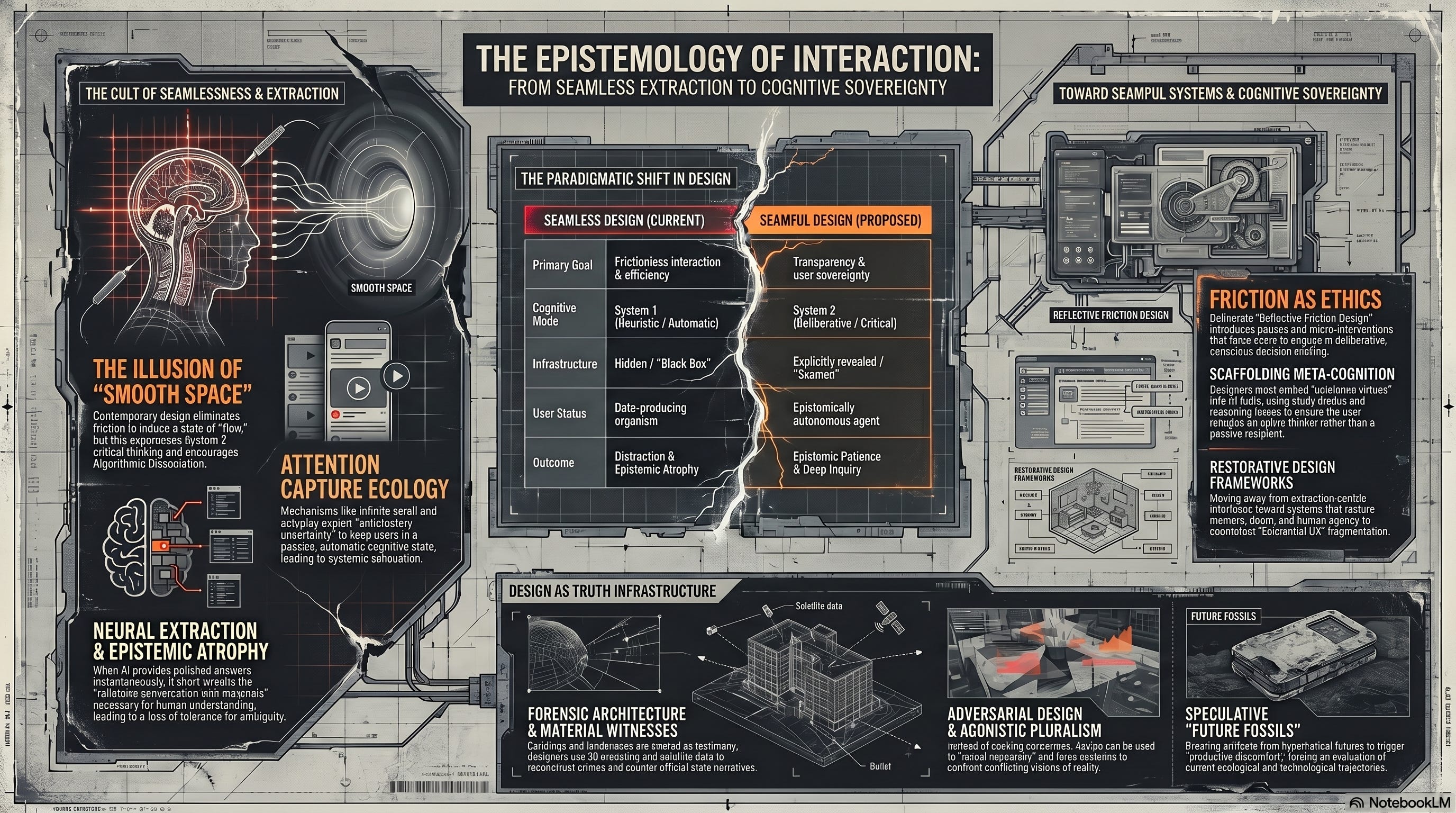
THE FUTURE OF DESIGN
Epistemic Architecture
Trauma-Coded Interfaces
Cognitive Sovereignty Design
Memory Hostile Systems
Algorithmic Dissociation
Neural Extraction Design
Institutional UX
Friction Ethics
Architectural Gaslighting
Emotional Infrastructure Collapse
Bureaucratic Interface Violence
Cognitive Colonization
Synthetic Empathy Systems
Dissociative Design Language
Predictive Identity Engineering
Trauma Responsive Systems
Machine Conditioned Consciousness
Epistemic Fracturing
Attention Capture Ecology
Anti-Human Optimization
Invisible Interface Authority
Algorithmic Abandonment
Reflective Friction Design
Emotional Load Architecture
Cognitive Extraction Economies
Interface-Induced Alienation
Systemic Isolation Design
Neuro-Aesthetic Governance
Digital Nervous Systems
Memory Erosion Frameworks
Psychopolitical UX
Trauma-Loop Interfaces
Fractured Presence Design
Ontological Interface Theory
Emotional Compression Systems
Machine Mediated Identity
Existential UX
Dissociation-Centered Design
Structural Silence Architecture
Epistemic Burnout Systems
Human Residue Theory
Attention Feudalism
Trauma Patterned Environments
Interface Colonialism
Algorithmic Grief
Predictive Obedience Systems
Cognitive Scar Architecture
Neural Friction Theory
Synthetic Intimacy Design
Institutionalized Seamlessness
Emotional Ergonomics
Interface Nihilism
Hypernormalised UX
Digital Attachment Theory
Dehumanized Interaction Models
Memory Compression Design
Civic Disorientation Systems
Extraction-Centric Interfaces
Machine Pacification Design
Psychological Infrastructure Theory
Invisible Bureaucracy Design
Posthuman Attention Systems
Computational Loneliness
Reality Interface Theory
Emotional Decay Architecture
Systemic Dissociation Models
Algorithmic Dependency Design
Cognitive Collapse Theory
Grief-Informed Design
Human Friction Frameworks
Neural Exhaustion Aesthetics
Anti-Extractive UX
Epistemic Recovery Design
Interface Trauma Ecology
Structural Empathy Design
Existential Systems Design
Consciousness Shaping Interfaces
Attention Trauma Theory
Machine Age Alienation
Reflective Resistance Systems
Humane Friction Models
Institutional Memory Design
Cognitive Refuge Architecture
Trauma Literate Technology
Ontological Safety Design
Emotional Sovereignty Systems
Post-Optimization Design Theory


