

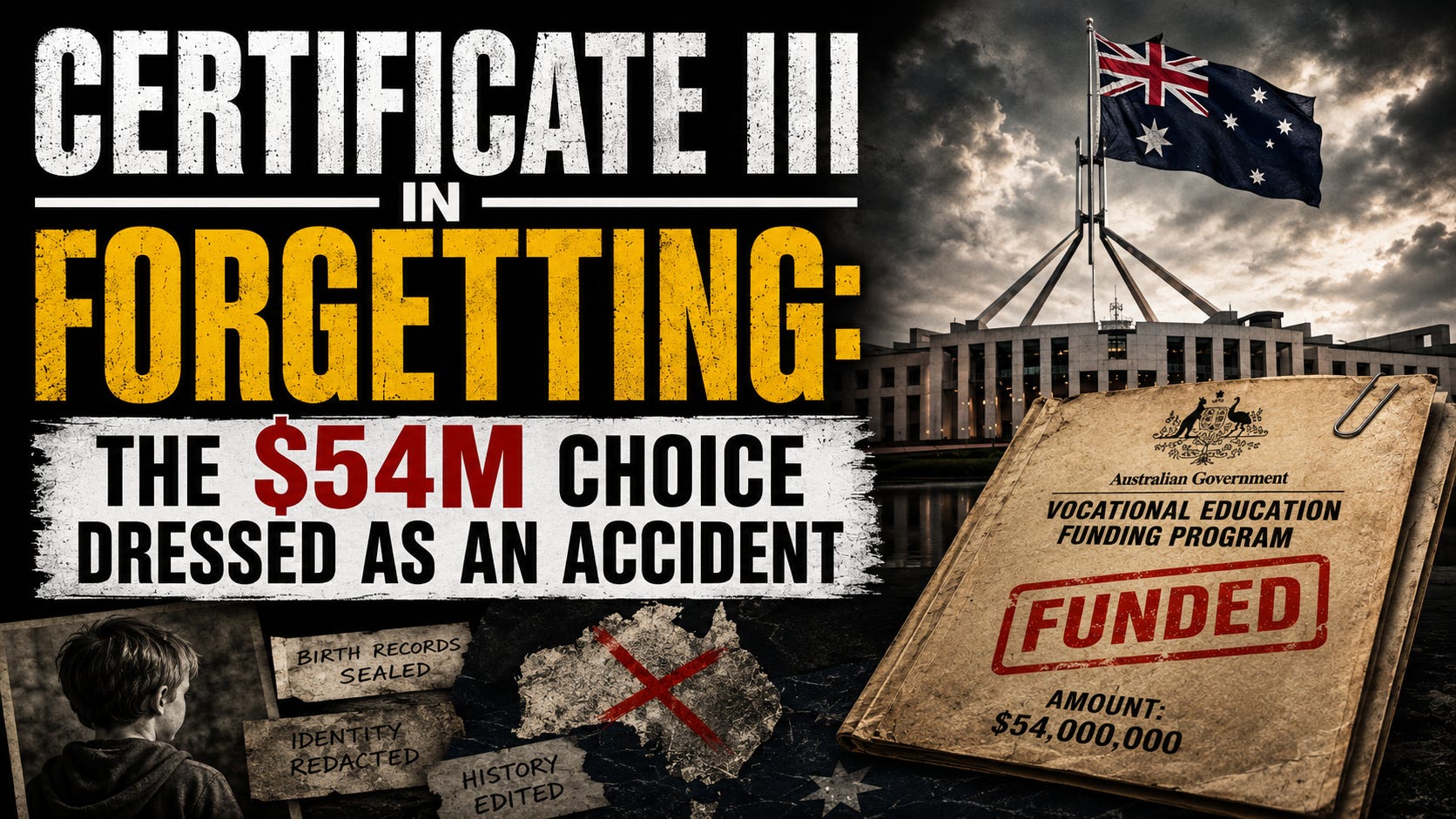
The Commonwealth pays more than fifty-four million dollars a cycle to train the workforce that handles separated children, ageing parents, and people at the thinnest moments of their lives. It never taught them you have an origin worth keeping.
There is a particular silence that arrives when you tell someone who works in care that you were adopted, and their face does not change.
Not cruelty. Cruelty would at least be a recognition. What arrives instead is a smooth, trained blankness — the expression of a person who has been credentialled to handle your body, your medication, your child, your file, and who has never once been taught that the missing half of your own history is a thing that can be done to a person. They nod. They move on to the next field in the form. And you feel the old subsonic hum start up under the floor of the conversation: the knowledge that the thing at the centre of your life is, to the system standing in front of you, not even a category.
I want to be precise about where that blankness comes from, because it is easy to mistake it for individual failure and it is not. The educator in the childhood room, the support worker at the aged-care bedside, the case manager with your file open — most of them are decent people doing brutal work for wages that insult it. The blankness is not theirs. It was installed upstream, in a document most Australians have never heard of, by a process that is funded, minuted, and endorsed by ministers. The blankness has a budget.
The credential
Nearly everyone who is paid to care for another human being in this country holds a piece of paper from the same source. It is called the CHC Community Services Training Package — the national set of qualifications and units that defines what a care worker is trained to know. Certificate III in Early Childhood Education and Care. Certificate IV in Ageing Support. Certificate III in Individual Support. These are the credentials behind the lanyard of the person who meets you at the worst and most vulnerable thresholds of a life.
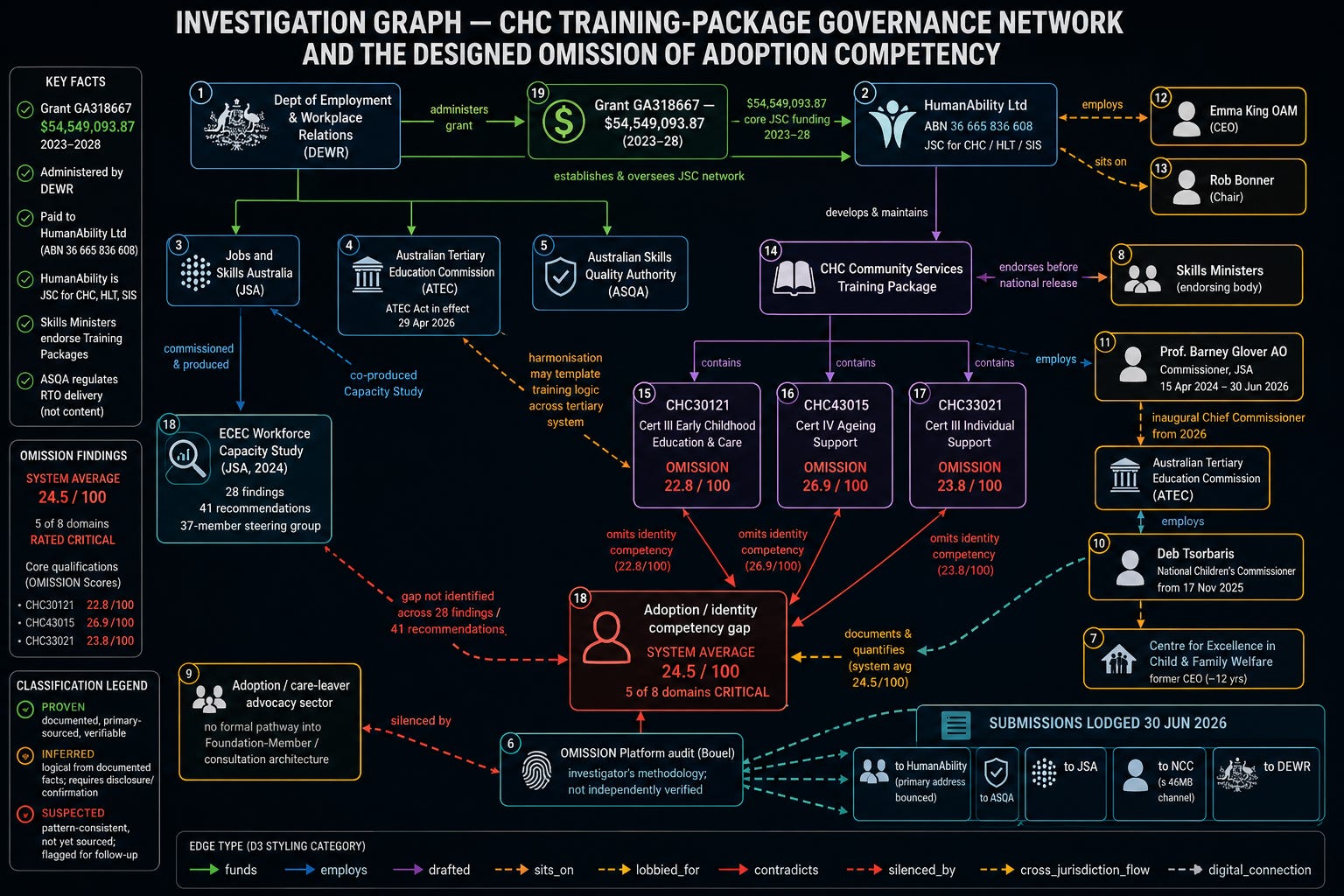
The package is owned and maintained by a body called HumanAbility — the Jobs and Skills Council for the care and support sector, an industry-led company established under the Commonwealth’s skills reforms. It writes and revises the qualifications for childcare, aged care, disability, youth work, child protection, case management, family support. It is funded to do this. The public record is exact about how much: a single grant, GA318667, from the Department of Employment and Workplace Relations — $54,549,093.87, running from mid-2023 to mid-2028. Fifty-four and a half million dollars to keep the national care curriculum, in the department’s own language, current and fit for purpose.
Hold that phrase. Fit for purpose. We are going to test it against the one purpose that matters to the people reading this.
The number
I built a tool (See - OMISSION Platform 2.2.1 below) that scores frameworks against the rights the people inside them are actually entitled to — eight of them, drawn straight from the international standards Australia has signed: continuity of identity, integrity of family, cultural continuity, information rights, agency, consent, self-determination, and the preservation of memory. Not soft values. The specific things a person loses when they are separated and the record is closed behind them.
Then I pointed it at the three foundational care qualifications.
CHC30121, early childhood: 22.8 out of 100.
CHC43015, ageing support: 26.9.
CHC33021, individual support: 23.8.
A system average of 24.5 out of 100 across the workforce that touches the human lifespan from the first daycare drop-off to the last bed. Five of the eight domains scored at Critical. The lowest of all was the first one — Identity Continuity — at 12.6.
Read that domain back in plain terms. Whether the workforce is trained to understand that a person can be deprived of the knowledge of who they are, and that helping them hold or recover it is part of the job. Twelve point six out of a hundred. The national training system produces practitioners who are, on the evidence of their own curriculum, structurally unequipped to recognise the single most defining fact about an adopted or separated person’s life. Not unwilling. Untaught. There is a difference, and the difference is the whole story.
A low score in one qualification is a drafting oversight. A low score in the same domain across three qualifications, across eight domains, across the entire span of care contact, is not an oversight. It is a property of the schema. Something that uniform was not forgotten. It was never a question.
How a blind spot gets governed
Here is where the two halves of this meet — the curriculum and the machine that maintains it — because the second is what makes the first inevitable.
In September 2024, Jobs and Skills Australia released a landmark study of the early childhood workforce, produced in partnership with the very body that owns the curriculum. It was serious work: twenty-eight findings, forty-one recommendations, a steering group of thirty-seven, a public consultation that drew more than fifty submissions. It asked, exhaustively, what the childhood workforce needs in order to be sustainable, skilled, and fit for the future.
In all of that, across all of those findings and all of those recommendations and all of those experts, the question of whether an educator should be trained to understand a child’s severed origins does not appear. The most comprehensive examination of the workforce’s future that the Commonwealth has commissioned did not identify the gap. It could not. The people who would have raised it were not in the room, because there is no door built for them.
This is the mechanism, and it is more elegant than any conspiracy. You do not need to suppress a question if the architecture ensures it is never asked. The consultation machinery — the steering groups, the technical committees, the membership structures — defines the boundary of what counts as a legitimate workforce need. Adoption competency, identity competency, the lived expertise of the separated: none of it has ever crossed that boundary. The fifty-four million dollars does not buy the omission. It maintains the conditions under which the omission is permanent — a curriculum kept forever “current” without ever being made to see.
The logic goes upward
You might hope this stays contained. It does not.
The Commissioner who ran that landmark study, Professor Barney Glover, finished his term at Jobs and Skills Australia on the thirtieth of June this year — and stepped directly into the chair of the brand-new Australian Tertiary Education Commission, the body created to break down the barriers between vocational training and higher education and fuse them into a single, seamless system. The stated goal is harmonisation: to make the whole of Australian tertiary education move as one connected thing.
Sit with what that means. The training logic that never learned to see identity — the logic that produced a 12.6 — is now being steered, by the same hand that oversaw it, toward the top of the entire tertiary structure. A blind spot is about to be scaled from a single training package to the architecture of the nation’s education system. Not through malice. Through continuity. The people who did not ask the question are the people now designing the frame that everything else will be built inside.
The window is open right now
There is a reason to write this in July and not in December. The early childhood qualification — CHC30121, the 22.8 — is under active review as I write, with its revised version scheduled to be finalised and endorsed by ministers around the middle of this year.
That is not an abstraction. It is a live document, open on someone’s screen, being rewritten. Every unit that goes in and every unit left out is a decision being made in this window. Which means the gap is, for a matter of weeks, not a permanent feature but an open question — the rarest thing in an entrenched system: a moment where naming it and renewing it are both still possible, and the choice has not yet closed.
The gap that no one owns
Ask who is responsible and you will watch the responsibility evaporate in your hands.
HumanAbility develops to the standards ministers set; it inherited this package, it did not invent the hole. The department funds the council and endorses through ministers; it does not write units. Jobs and Skills Australia studied capacity, not rights; the gap was outside its terms. The regulator, ASQA, polices the quality of delivery, not the content of the curriculum; content belongs to the council. The National Children’s Commissioner can receive a systemic finding, can research it, can advise the minister — and cannot compel a single word of a single unit to change.
Every one of those statements is true. That is exactly the point. No single body owns the omission, so no single body is obliged to repair it. This is the finished form of the Architecture of Silence: not a locked door with a keyholder you can name, but a design failure distributed so evenly across so many hands that there is no hand you can hold to it. The silence is not kept by anyone. It is maintained by everyone, and therefore by no one.
I lodged the audit anyway — five submissions, on the thirtieth of June, to all five desks at once. To the council, the department, the workforce authority, the regulator, and the Commissioner. Not because any one of them can fix it alone, but precisely because each of them can otherwise pass it to the next. Put the same finding on every desk in the room and the passing has nowhere to go.
What it would cost to see
Here is the part the system would least like said out loud: fixing this is cheap.
It is not a new building or a new agency or a decade of reform. It is a competency. It is teaching the person in the childhood room, at the bedside, over the open file, that some of the people in front of them have been deprived of their own origins, that the record is not always neutral, that helping someone hold or recover the knowledge of who they are is inside the job and not outside it. It is a handful of units and the will to endorse them. Against fifty-four million dollars a cycle, it does not register as a rounding error.
The reason it has not been done is not cost. It is that the workforce trained not to see the wound is easier to run than the workforce trained to see it. A worker who understands what was taken asks harder questions, keeps better records, refuses smoother forms. The blankness is not a failure of the system. For the system, the blankness is efficient.
So I will end where I began, on the face that does not change — but I will tell you what has changed underneath it. The gap now has a number. It has been measured, scored, and placed in the record, on five desks, in the exact weeks the document is open for rewriting. The blankness was always a choice dressed as an accident. Now the accident has been costed, and the choice is visible, and it is being made — this year, in this window — by people whose names are on the funding line.
You were not forgotten by the person whose face did not change. You were left out of the curriculum that trained them. That is a smaller and more fixable thing than grief, and it is the reason to keep the record open. Erasure that was taught can be un-taught. The proof that it is a choice is the same proof that it can be chosen differently — and the desk it has to be chosen at is open right now.
Companion investigation:

OMISSION Platform 2.2.1
https://github.com/sbouel72/omission-platform
OMISSION-VET-Reform-Package-2026


