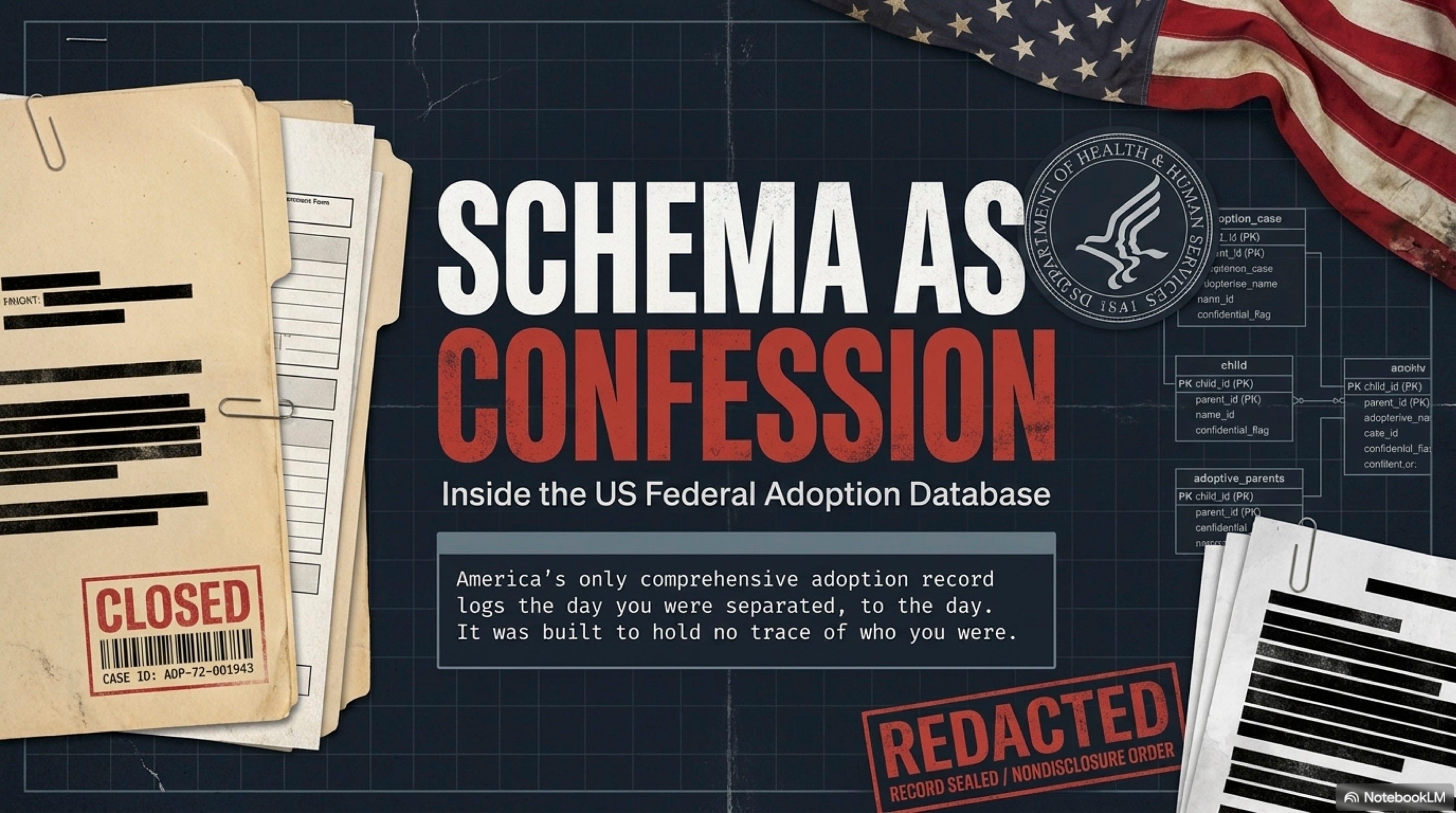

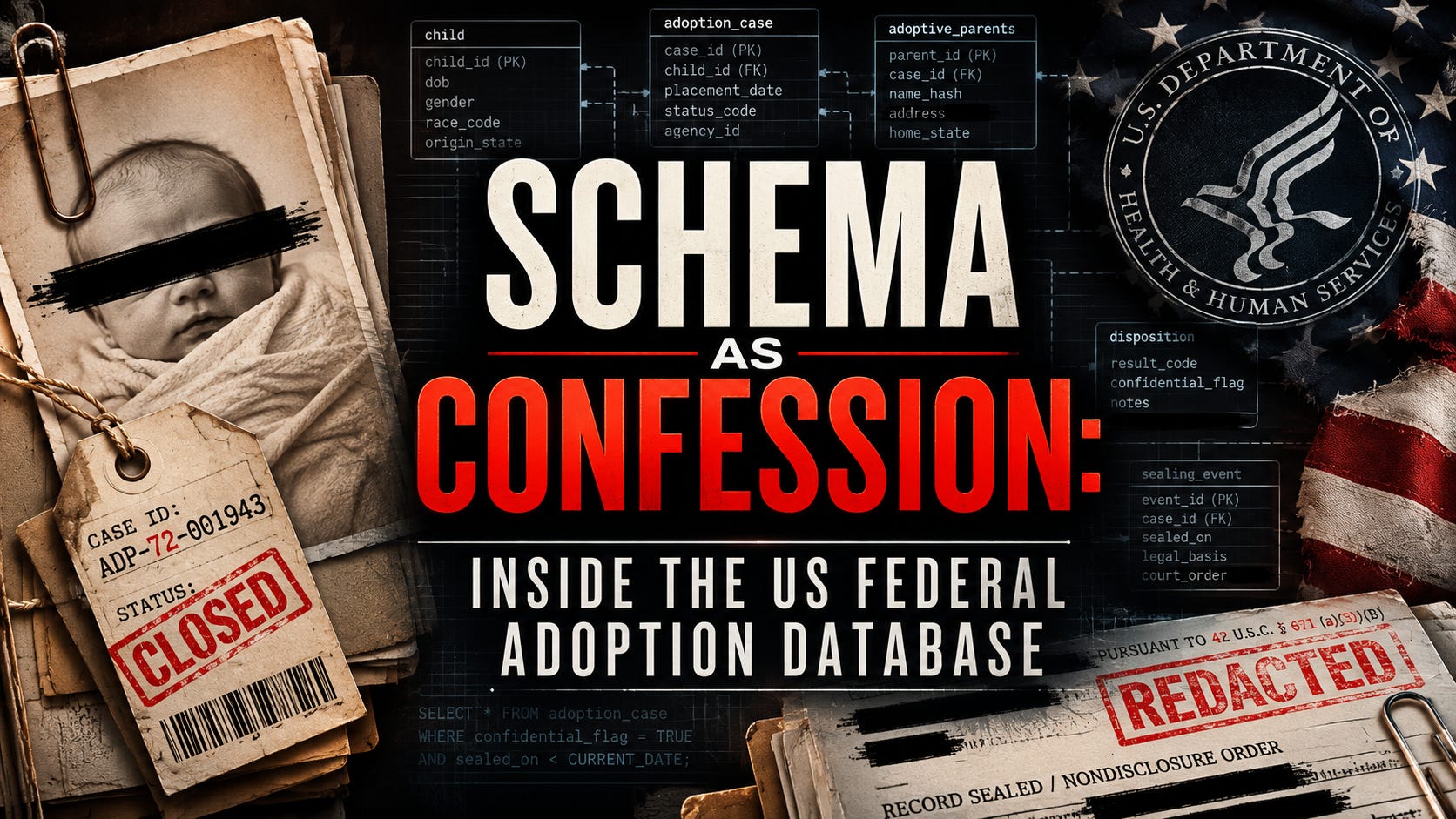
There is a federal system that knows the exact day a stranger became your mother by law, and cannot tell you the name of the woman who bore you.
It is called AFCARS, the Adoption and Foster Care Analysis and Reporting System, and it is the only comprehensive record the United States keeps of every adoption completed with federal money. It logs the date your first parents’ rights were terminated. It logs the date the adoption was finalised. It logs your sex, your race, your ethnicity, close to a hundred and ninety separate facts about the child you became. Not one of them is the name you were born under. Not one of them is a thread you could follow back to the people you came from. The system counts the severance to the day. It keeps nothing of what was severed.
I am not American. I was taken in Queensland, half a world and a whole legal system away from Washington. And still I recognised this architecture the moment I read its schema, the way you recognise your own handwriting in the dark, because the shape of it is the same everywhere it appears. Somewhere there is a certificate that says two people who were strangers to my first hours are my mother and father, that names their address as the place I began, that reads, by law, exactly as if I had been born to them. My original certificate sits behind that one, sealed. The state did not lose it. The state replaced it, and kept the replacement where the truth used to be.
That is the thing to understand before anything else. This is not a filing error. It is a design.
What the schema confesses
Read AFCARS not as a form but as an object, and it starts to talk.
The current record collects roughly a hundred and eighty-six data points on a child in care, plus a separate file on finalised adoptions. Across all of them, the birth parents appear only as a scatter of demographic characteristics, a race here, a tribal-membership flag there. Never as people. Never as a name a grown adoptee could one day ask for. The federal rulebook then goes further than silence. It encrypts the child’s identifier so the record cannot be linked back to the person. It recodes every child’s day of birth to the fifteenth of the month, blurring the one date a body actually remembers. In small communities it dissolves children into aggregates so none can be picked out.
And here is the part they wrote down themselves. In its own rulemaking, the agency states plainly that it strips this information because the data could otherwise reveal a child’s identity. They understood exactly what the record was capable of returning to us. They built it, on purpose, so that it never could.
A database with no field for your origin did not misplace your origin. It was constructed with nowhere to put it. That is what a schema is: a set of decisions about what is allowed to exist. The absence of your name in AFCARS is not a gap in the data. It is the data. It is the Architecture of Silence, rendered not as a slammed door or a redacted page but as the quiet grammar of a government spreadsheet, and a spreadsheet cannot be shamed, cannot be appealed to, cannot be asked to remember what it was engineered to forget.
The second lock
The federal system does not act alone. It is only the first half of a machine that needs two turns to finish.
The case record, the living file with the real names in it, sits in state systems. Then the state performs the act that completes the erasure. When your adoption is finalised, your original birth certificate is sealed and a new one is issued in its place, one that names the people who raised you as the people who bore you, that carries no reference to the fact of adoption at all. In every state in the country, the amended certificate is written to be indistinguishable from the record of a child born to its parents. Your history is not annotated. It is overwritten.
And then, in most of the country, the state locks the original away from the only person with an unarguable claim to it. As of the first of July this year, seventeen states let an adult adoptee simply ask for their own original birth certificate and receive it. That leaves thirty-three states and the District of Columbia where you cannot get the record of your own birth without a court order, a stranger’s permission, or the luck of having been born inside the right band of years. Thirty-three jurisdictions where an adult must petition a judge to be told their own name.
Put the two halves together and you see the whole. The federal layer records that you were cut loose and keeps nothing that would lead you home. The state layer holds the truth and seals it. Between them there is no part of the apparatus whose job is to keep your origin and give it back to you. Not one office in the entire structure is charged with that single, obvious, human task. The design does not merely fail to return us to ourselves. It was never built to.
Counted, not known
This is the condition I keep circling, the one the frameworks were built to name. The Fifth-Dimensional Split: the gap between the self that lived and the self the paperwork authorised, held open for a lifetime because the record that could close it is sealed. You are, in the eyes of the most comprehensive system your government maintains, fully counted and entirely unknown. Every measurable fact about you is captured. The one fact that is yours is encrypted beyond even the agency’s own reach.
There is a particular vertigo in learning that you exist in a national database as a de-identified row. That the state can produce, on demand, the day you were handed over, the category of your race, the reason your first parents were ruled unfit, and can produce none of it as you. You become a data point in a system built to see populations and refuse persons. The gravity of that absence does not lessen with age. It is the Identity Gravity Well, the steady downward pull of a missing centre, and no amount of being counted has ever once filled it.
I want to be precise here, because precision is the only respect this subject allows. The people who built AFCARS are not cartoon villains hunched over our files. The system is a statistical instrument doing exactly what a statistical instrument is asked to do, which is the entire problem. The cruelty is not in a malicious hand. It is in the decision, made and remade across administrations of both parties, that adopted children are a population to be tallied rather than persons with a right to their own beginnings. The erasure is not a bug in the system. It is the system, performing to specification.
The turn
If I stopped there, I would be lying by omission, and this publication does not trade in despair any more than it trades in comfort.
Because the architecture is a default, not a fate. Sealing is what happens when no one intervenes. But people are intervening. Seventeen states and rising have legislated the original record back into adult adoptees’ hands, and the newest of them, Virginia, opened its files this very month. In California, a bill named SB 381 has passed the Senate without a single dissenting vote and is moving through the Assembly. It would do the plain thing: require the state to give an adopted adult their own original birth certificate, and, just as importantly, repeal the provision that let the amended certificate omit where we were actually born. It does not take effect until 2028. It is still worth every letter written in its support, because each state that opens its records is a state that stops completing the federal government’s erasure on its own citizens.
And there is an act available to every one of us right now, before any legislature moves. Name the architecture. A silence that is understood as a design loses the one thing that kept it working, which was our belief that it was natural, that this is simply how adoption is, that the sealed record is the weather rather than a choice a person signed. It is not the weather. It has an author, a date, a rulemaking record, a signature block. Everything about it is a decision, which means everything about it can be decided differently.
I still do not have every page of my own beginning. Many of us never will. But I have stopped mistaking the lock for the law of nature, and that is not a small thing. To know precisely how you were erased is to hold the first piece of yourself that no schema can encrypt. They wrote down the date. They deleted the name. We are the ones who get to write it back.
If you would like direct access to my research, please message me.
From the reporting: AFCARS data-element detail and the federal de-identification design are drawn from the 2020 AFCARS final rule (45 CFR § 1355.44); state original-birth-certificate access figures are from the Adoptee Rights Law Center’s 50-state review, current to 1 July 2026; SB 381 status is current to the California Legislature record.
Resources