

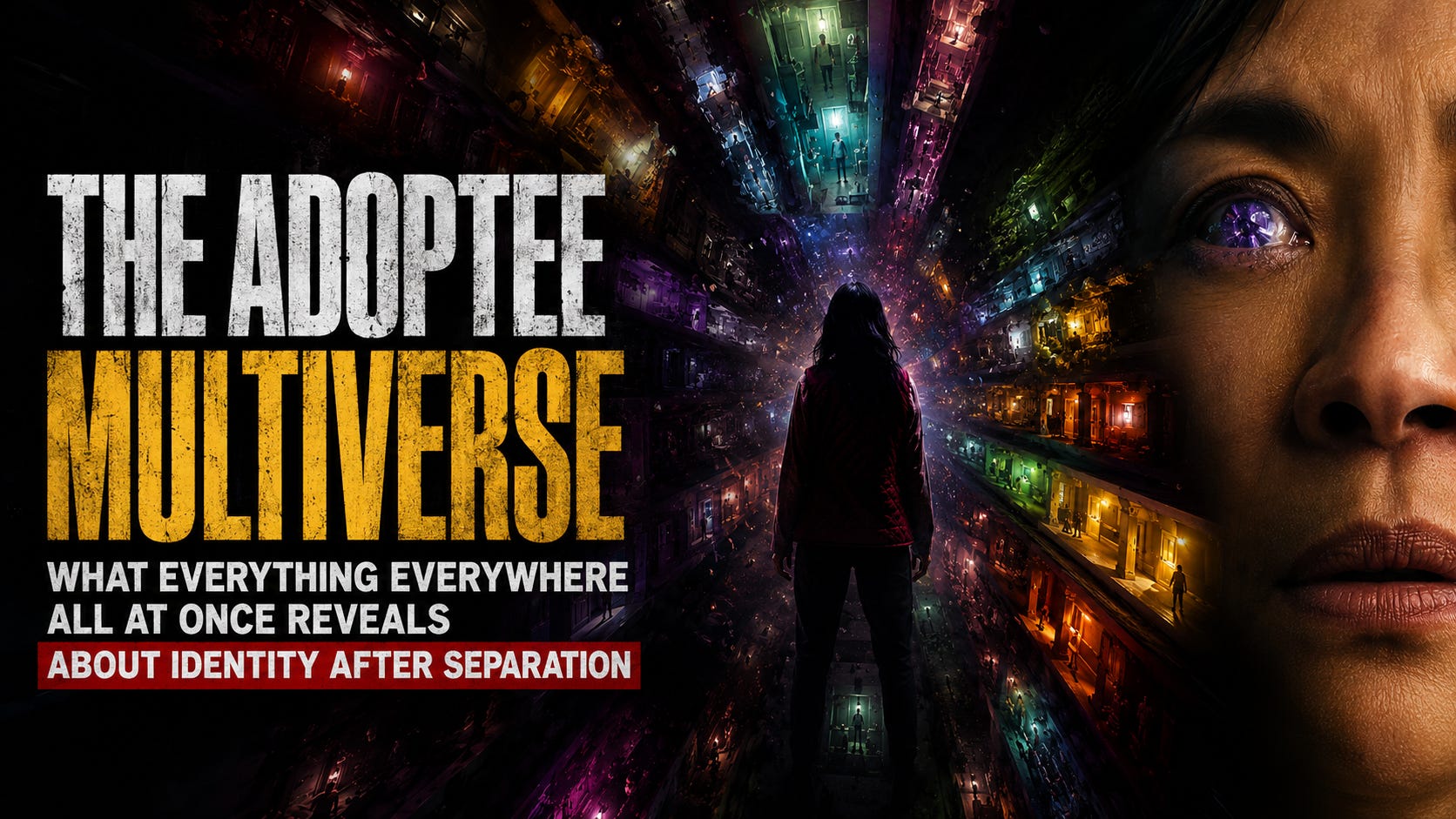
Choosing Everything Everywhere All at Once as a lens for the adoptee experience isn’t just metaphorical—it’s surgical. The film captures something most adoption narratives avoid: the claustrophobic, sensory-overload reality of carrying the phantom weight of unlived lives as a constant psychological companion.
In the movie, Evelyn Wang doesn’t casually contemplate alternate paths; she fractures under their weight. She is forced to experience the raw, visceral texture of universes where she became a movie star, a glamorous singer, or a martial arts master—all while standing in her actual, exhausting reality: a drab laundromat surrounded by tax audits, a failing marriage, and a daughter she cannot reach.
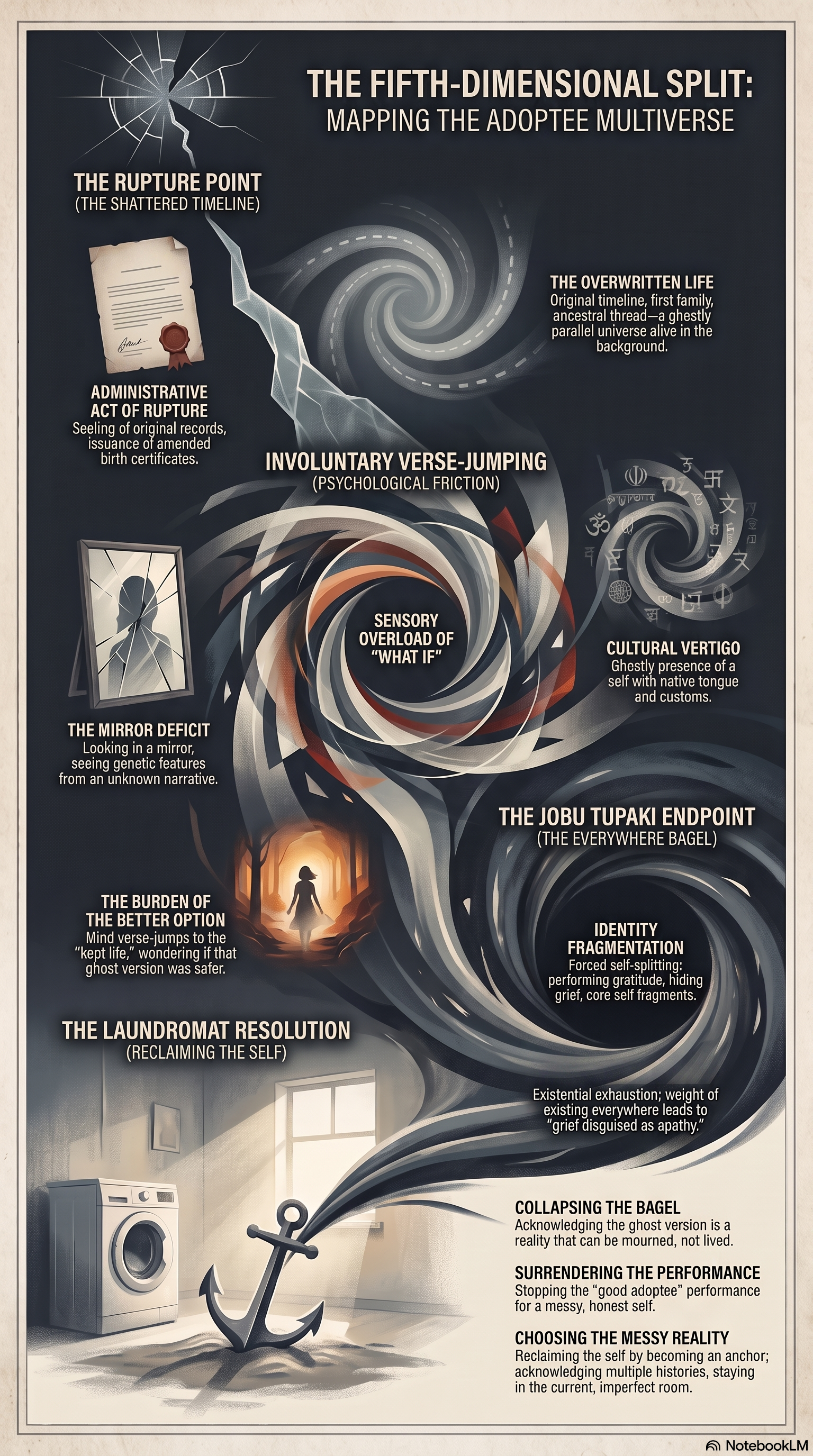
Strip away the sci-fi spectacle, and the mechanics of Evelyn’s multiverse offer a stunningly precise forensic model for what I call the Adoptee Multiverse—a psychological architecture built on rupture, haunting, and the exhausting labour of holding multiple selves together.
1. The Rupture Point: Where the Timeline Shatters
In the film, Evelyn’s alternate universes branch from specific pivotal choices. The most profound rupture occurs when she chooses to leave her home, her father, and her country to follow Waymond to America. That singular decision shatters her timeline into infinity.
For the adoptee, the rupture point is not a choice—it is a structural event imposed upon them: the severance from the maternal baseline and original lineage.
The Root Timeline forks at The Rupture: Separation & Legal Re-routing—and splits into two lives:
Universe A — The Kept Life (The Ghost Self): same culture, same language, same biological mirroring.
Universe B — The Adopted Life (The Present Self): amended records, new family, synthetic baseline.
This is not metaphorical loss. It is the direct output of an administrative act: the moment a court seals one record and issues another in its place, the original timeline is not just abandoned—it is legally overwritten. The life where you kept your name, spoke your mother tongue, grew up looking like the people who raised you, and inherited an unbroken ancestral thread does not simply vanish. It remains alive in the background of consciousness as a ghostly parallel universe, humming with the quiet, persistent question: What if?
This is not idle speculation. It is a structural wound. The adoptee does not have one origin story—they have two, and neither fully belongs to them. The kept life becomes a phantom limb, aching in ways that are difficult to name.
2. Involuntary Verse-Jumping: The Sensory Overload of “What If”
Evelyn accesses alternate selves through “verse-jumping”—a chaotic process that floods her brain with the memories, skills, and sensations of other lives simultaneously. It leaves her gasping, disoriented, and overwhelmed by the sheer scale of who she could have been.
This is a near-perfect metaphor for the constant, involuntary mental verse-jumping that many adoptees navigate daily. It is not daydreaming—it is psychological friction, a low-grade hum of dislocation that never fully turns off:
The Mirror Deficit: Looking in the mirror and seeing facial features that belong to a completely different genetic narrative—forcing you to wonder whose eyes or smile you are wearing.
Cultural Vertigo: Walking through your country of origin, feeling the heavy, ghostly presence of a version of you that speaks the language fluently, understands the customs organically, and actually belongs.
The Burden of the Better Option: If the adoptive environment becomes abusive, neglectful, or deeply invalidating, the alternate universe screams louder. The mind constantly verse-jumps to the life that was severed, wondering if that ghost version of you was safer, happier, or more loved.
The brutality of this awareness is that you are rarely allowed to inhabit just one room. You carry the sensory static of a life that was taken, bargained away, or simply never permitted to exist. You become a dual citizen of two realities that can never merge—and the border crossing is never complete.
3. Joy Wang and Jobu Tupaki: The Trauma of Inherited Splitting
The most devastating relationship in the film is between Evelyn and her daughter, Joy. In the Alpha Verse, an alternate Evelyn pushes Joy so relentlessly to verse-jump that Joy’s mind completely fragments. She becomes Jobu Tupaki—an omnipotent, nihilistic being who experiences every universe, every choice, every outcome simultaneously.
Because Jobu sees everything, nothing matters to her anymore. She builds the Everywhere Bagel—a black hole of pure collapse—simply because she is exhausted by the infinite weight of existing everywhere at once.
The Jobu Tupaki Analogy: Jobu represents the ultimate endpoint of systemic identity erasure. When an adopted person is forced by their environment to constantly split themselves—to be the perfect, grateful child for their adoptive family, to hide their grief, to perform a culture they were never raised in, to search for biological roots while suppressing the ache of missing them—their core self begins to fragment.
You become a psychological chameleon, existing in so many emotional worlds just to survive that you risk experiencing the same existential exhaustion as Jobu. The internal voice starts to whisper: If I am a completely different person depending on which family, which record, or which country I am standing in... then who am I actually? Does any of this matter?
The Everywhere Bagel is not just nihilism—it is grief disguised as apathy. It is the exhaustion that comes from being asked, over and over, to be everything to everyone while never being fully seen as yourself.
4. The Laundromat Resolution: Reclaiming the Immediate Self
The climax of the film does not involve Evelyn abandoning her messy, painful reality to live in the glamorous movie-star universe. Instead, she looks at the absolute chaos of the multiverse, looks at her flawed husband and her hurting daughter in the middle of a mundane laundromat, and makes a radical choice:
“Of all the places I could be, I just want to be here with you.”
For the awakening adoptee, this is the hardest, most profound integration work available. It is the transition from being haunted by the multiverse to actively grounding yourself in the present:
Collapsing the Bagel: It means acknowledging that the ghost version of your life—the life that was kept, the unbroken history—is a reality you can mourn, but it is a reality you cannot live. Grief and acceptance must coexist.
Surrendering the Performance: You stop verse-jumping to find a perfect, pristine version of yourself that makes everyone else comfortable. You stop trying to be the “good adoptee” who never complains, the “grateful child” who never questions, the “cultural bridge” who never falters.
Choosing the Messy Reality: You look at your actual, fragmented history—the amended birth certificate, the severed roots, the adoptive complexities—and you decide that this specific, scarred version of you is the one worth fighting for.
You do not heal by erasing the parallel timelines or pretending the rupture did not happen. You heal by becoming the anchor. You acknowledge that you are a product of the multiverse—that you carry multiple histories, multiple griefs, multiple possible selves—but you claim the right to stand firmly in the current room, owning every piece of the wood, the wire, and the glass that brought you here.
Coda: The Radical Choice of Presence
In the end, Everything Everywhere All at Once offers a profoundly adoptee-centred lesson: presence is not passive acceptance—it is an active, daily choice to anchor yourself in the life you actually have, rather than the life you might have had.
The multiverse does not disappear. The grief does not vanish. The ghost selves remain, flickering at the edges of consciousness. But you learn to hold them differently—not as chains, but as context. Not as prisons, but as part of the architecture of a self that is complex, layered, and irreducibly whole.
You become the one who says: Yes, I am from everywhere. Yes, I am from nowhere. But here—right here, in this imperfect moment, with this imperfect family, this imperfect history—I choose to stay.
That is not defeat. That is the most radical act of self-possession available to anyone who has ever been told their story belongs to someone else.
Further Reflections
For adoptees: What does it feel like to sit with your own “Everywhere Bagel”? Where do you feel the pull of collapse most strongly?
For allies: How can you create space for adoptees to exist without demanding they perform a single, coherent narrative?
For therapists and practitioners: How might the multiverse framework reshape how we approach identity work, grief, and integration with adopted clients?
“The only thing I do know is that we have to be kind. Please, be kind. Especially when we don’t know what’s going on.” — Waymond Wang
Perhaps that kindness begins with allowing ourselves—and each other—to exist in all our fragmented, multitudinous, contradictory glory.
Presentation


