

THE PILL THAT WAS NEVER OFFERED
In The Matrix, the choice is the whole point. Blue pill: stay inside the comfortable fabrication. Red pill: wake up in the cold machinery of the real. The hero gets to decide. That is what makes him the hero.
Adoptees never decided anything. The decree was signed before we could speak. The certificate was amended before we could read. The legal fiction of our parentage was entered into the record while we were still learning our mother’s heartbeat from the outside. The red pill was not offered to us. It was dissolved into the paperwork and administered at birth.
Society, meanwhile, took the blue pill voluntarily and has never once looked back. For decades the public has been fed a benevolence narrative: rescue, “forever families”, the chosen child. Behind that curated surface sits an architecture of legal fictions, state-sanctioned identity replacement, and a multi-billion-dollar market in infants. Seen from inside, adoption is not a social service with occasional flaws. It is a construct — built to manage trauma out of public view, to move human beings as resources, and to keep the machinery fed. Call it what it is: a Matrix.
Here are seven things you can only see from inside it.
1. THE PROPHECY TRAP: “CHOSEN” IS A LEASH
Neo is told he is The One. It feels like destiny. The Architect later explains it was a control mechanism — a way to manage anomalies and reset the system.
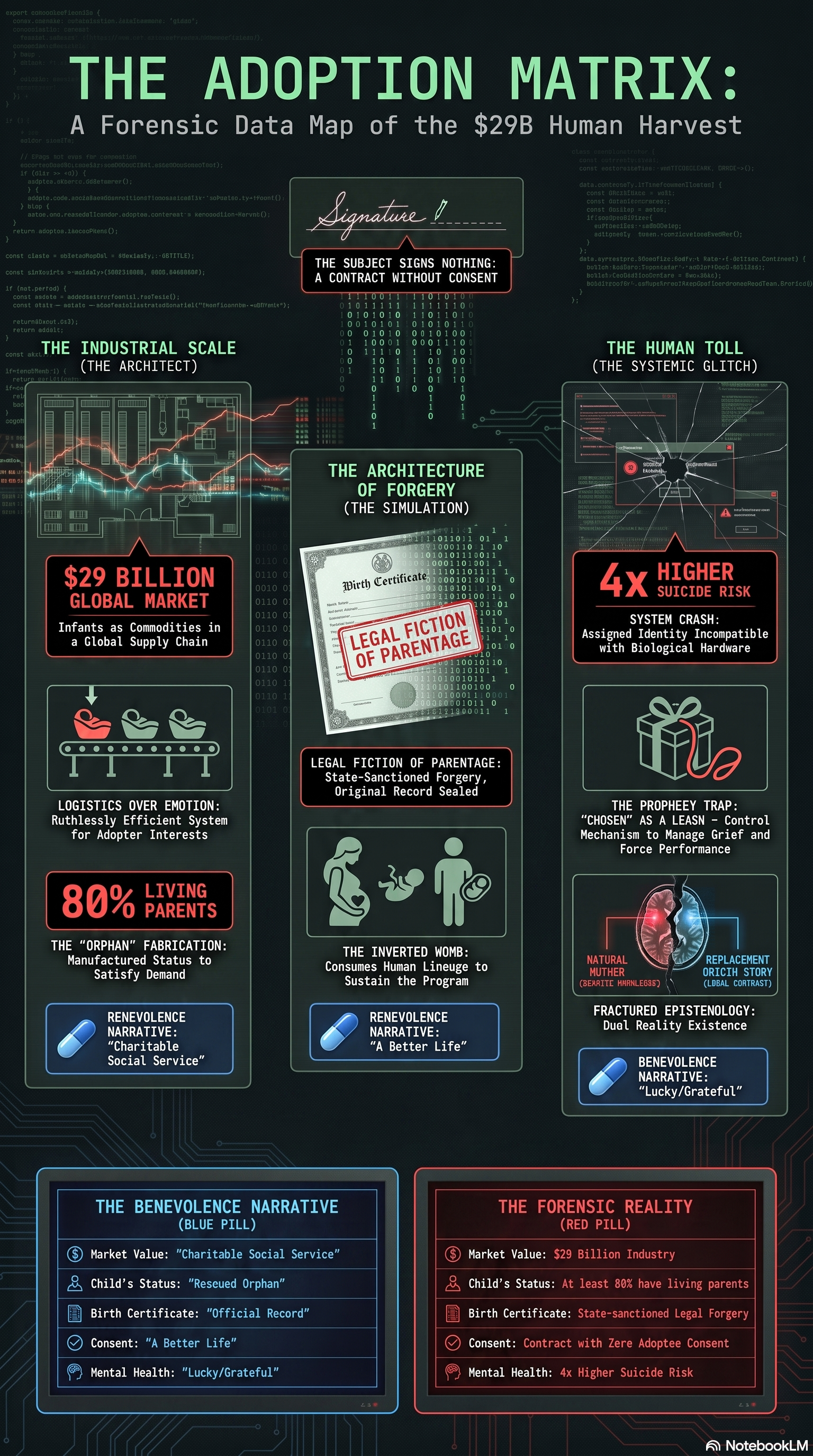
Adoptees are raised inside the same prophecy. Chosen. Special. A gift. These words are handed to us as if they were freedom, and they operate as the most refined control mechanism the system owns. If you are chosen, what right do you have to grief? If you are special, why are you searching — aren’t they enough? If you are a gift, why do you feel like stolen property?
The exceptionalism is a leash. It exists so you will perform the healing of the adoptive family and never make anyone look at the severance underneath it. Neo believes he is breaking the cycle; he is fulfilling it. The adoptee believes they are completing a family; they are validating an industry. When society calls an adoptee “lucky”, it is not seeing a person. It is admiring a successful product placement.
I know the weight of that leash from the inside. It sits in the chest, low and constant — the hum under the script. You feel it every time gratitude is expected before grief is permitted.
2. THE ARCHITECT DOESN’T HATE YOU. IT’S WORSE THAN THAT.
The question that eats adoptees alive is emotional: why did she surrender me? Was I unwanted? The question assumes the system runs on feeling. It does not. It runs on logistics.
The adoption industry is a $29 billion market, and it obeys the coldest law there is: supply and demand. When demand for infants rises, supply must be secured. In the “fetal fields” of this economy, the orphan is largely a fabrication — at least 80 per cent of children labelled orphans have one or both parents living. The system does not take children because it hates them. Hate would mean you mattered enough to be targeted. It takes children because they are a resource, and the market needs stock.
This is the Maintenance Economy with its skin peeled back. “The best interests of the child” is frequently a legal fig leaf laid over the best interests of the adopter — the paying party. The mother who “gave up” her child, in the language society prefers, was in most eras and most systems subjected to pressure that left no real choice: poverty, coercion, manufactured consent. You were not a protagonist in an emotional drama. You were inventory in a supply chain. The Architect is not cruel. The Architect is indifferent, and indifference scales better than cruelty ever could.
3. ZION IS JUST ANOTHER POD
Every adoptee carries the escape fantasy in some form. Find the natural family — find Zion — and the real world begins. The simulation ends at reunion.
Except Zion, when Neo reaches it, is another system. It has a council, hierarchies, military orders and a prophecy dictating exactly what he must do. Escaping one contract means signing another.
So it is with reunion. The adoptee who finds their family of origin often finds a mother still entangled in the poverty or coercion that took her child, a family with its own vaults and hierarchies, and a fresh set of performance demands: the trophy of a mother’s redemption, the symbol of a reunion gone right, the grateful survivor. Society adores the reunion storyline because it closes the wound on camera. It cannot see that for many adoptees the rupture of reunion is simply another adoption — another identity assigned by others, another contract we never signed, and this time nowhere left to run.
This is not an argument against searching. It is an argument against believing the search ends anywhere but in yourself. There is no room at the end of the corridor where someone hands your identity back intact. There is only the corridor, and the person walking it.
4. THERE IS NO SPOON. THERE IS NO SEAL.
The child in the film tells Neo the truth: there is no spoon. The object is a construct. Bend yourself, not it.
Here is the adoptee’s version. There is no original birth certificate — not one you are permitted to touch. The State seals the true record and issues an amended one listing the adoptive parents as your biological origin. This document is a legal fiction with full legal force. It is accepted by every government office, every school, every hospital, every court. A fabrication, notarised.
I have one. Millions of us do. It is a strange thing to hold a government document that lies about your body.
And the body keeps the score the paperwork suppresses. Adoptees are four times more likely to attempt suicide than non-adopted peers. When the signal breaks, the system’s docbots — the agencies, the courts, the clinical gatekeepers — move to pathologise the adoptee rather than examine the forgery. The person is treated as the malfunction. The document is never on trial. This is the Architecture of Silence operating exactly as designed: the record sealed, the replacement enforced, and the human being running software incompatible with their own hardware, then blamed for the crash.
5. RAGE IS THE VIRUS THE SYSTEM CAN’T PATCH
Society has a name for the adoptee who sees all this: angry. The angry adoptee is a stock character, a malfunction, a case study in poor adjustment. But watch what the rage actually does inside the system, and you find Agent Smith — the anomaly that stops obeying and starts replicating.
Adoptee rage is not a failure of character. It is a correct response to a condition that would be called illegal in any other context. When an adoptee names the machinery plainly — the commodification of children, the state-sanctioned taking, the falsified record — the reaction is not debate. It is quarantine. Hostility, pathologising, exile from the comfortable conversation. Because the truth is viral. If one adoptee is right about the machinery, every adoption narrative becomes suspect, and the entire operation loses its cover story.
They are not afraid of our anger because it is irrational. They are afraid of it because it is accurate.
6. THE INVERTED WOMB: HARVESTING THE LINEAGE
The word matrix comes from the Latin mater. Mother. Womb. The Wachowskis chose it deliberately, and the irony cuts to the bone. A mother gestates a child by self-consuming — her nutrients, her oxygen, her body given over to another life. The machine inverts this: it consumes the human to sustain its own programme. One gives life through sacrifice. The other drains life for fuel.
The adoption system runs the same inversion, and it does not stop at the individual. It harvests the lineage. By rewriting your name and sealing your origin, the system terminates your line on paper and grafts your reproductive future onto the adoptive one. Your children inherit a history that is not theirs. You become the vessel through which your ancestors are extinguished and a legal fiction is perpetuated into the next generation. Society calls this legacy. The systemic reading is plainer: energy production — one bloodline’s continuity extracted to power another’s.
This is the Identity Gravity Well at generational scale. The severance does not happen once. It keeps pulling, through you, at everyone who comes after — until someone names it and interrupts the loop.
7. EVERYONE IS PLUGGED IN. ADOPTEES HAVE SEEN THE WIRES.
The deepest level of this is uncomfortable for the non-adopted reader, so I will say it plainly. The State is the ultimate Architect, and not only for us. No citizen consents to the social contract. You were born into a nationality, a tax file, a legal identity — all assigned, all governed by the fiction of tacit consent. You never signed either.
The difference is that the non-adopted sleep comfortably inside a “natural” identity, and adoptees have seen the wires. We know identity is a script written in a courthouse and filed in a vault, because we have watched ours be rewritten. The machines are not waiting in some dystopian future. They are in the records offices now, liquefying the past to feed the simulation of the present. This is Non-Adoptee Bias in its purest form: not malice, but the sedated certainty of people who have never had reason to check whether their paperwork tells the truth. Ours didn’t. That is the only difference between us. We are your evidence.
BEYOND THE TWO PILLS
Here is where the film’s metaphor runs out, and where the work actually begins.
Both pills are scripts, and both scripts were written by the Architect. The blue pill — compliance, gratitude, the state-sanctioned lie — is obviously a cage. But the red pill as popularly imagined, the rebellion, the search, the reunion that fixes everything, leads to Zion. Another pod. Another role assigned by someone else.
The third option is not escape. There is no walking out of a system that holds legal title to your documents, and pretending otherwise is just one more comfortable fiction. The third option is authorship. Seeing the code does not dissolve it — the seal stays sealed, the amended certificate stays legally “true” — but it breaks the code’s claim on your interior. The prophecy trap loses its grip the moment you name it as a trap. The gratitude contract is void the moment you recognise you never signed it.
So start where the agency actually lives. In the body, which knew the truth before any document contradicted it. In the attention, which can be trained on the mechanism instead of the wound. In the record, which can be demanded, legislated open, testified into daylight — as adoptees are doing right now in committee rooms and inquiries on two continents. In the telling, which turns one person’s forgery into everyone’s evidence.
We inhabit a system that tells us it loves children while it extracts their identities to meet market demand. That is the tragic reading, and it is true, and I refuse to end there. There is no spoon. There is no seal — not one with any authority over who you actually are. You were never the one choosing. You are now.


