


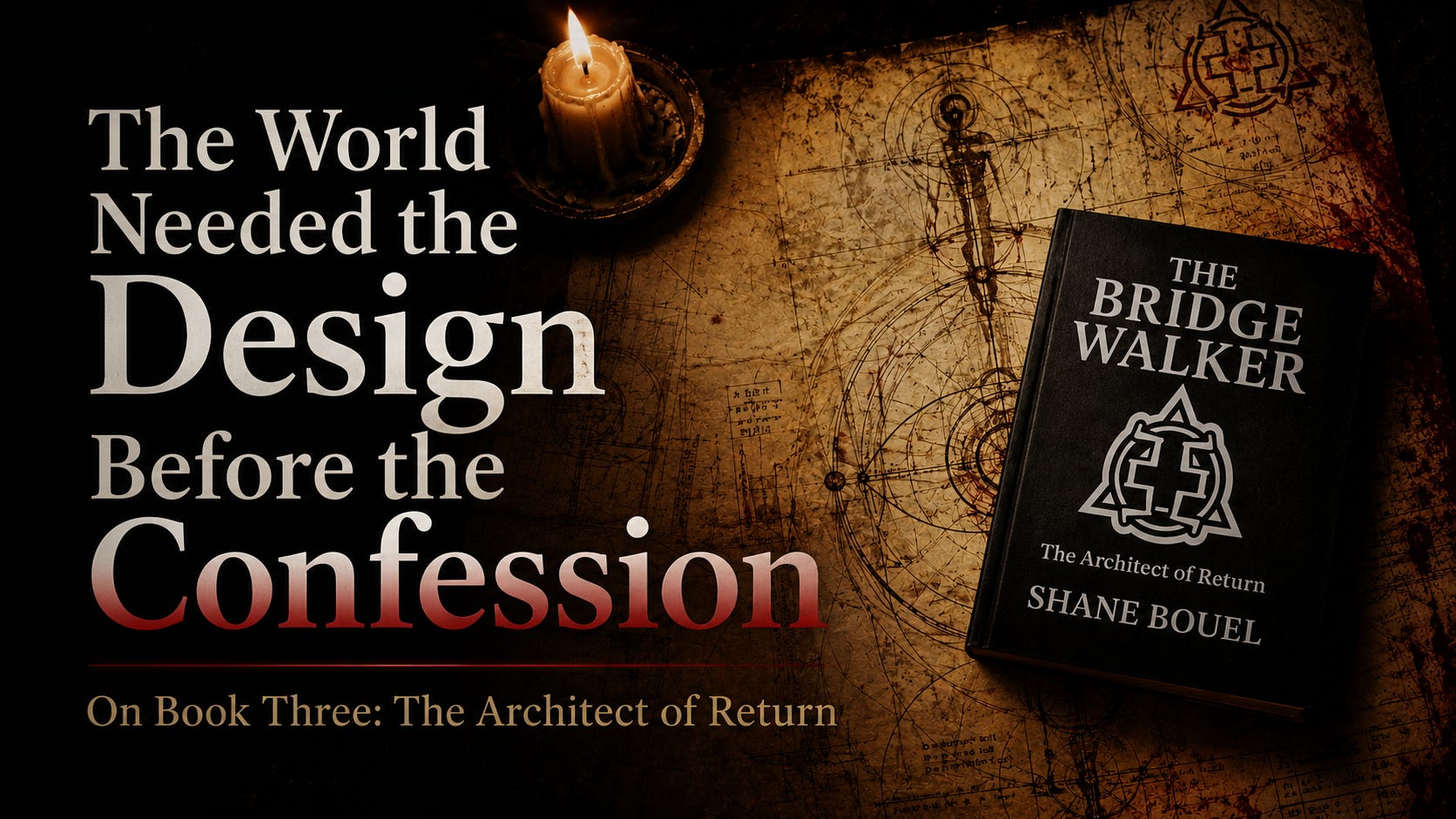
The Bridge Walker Series opens — not begins, but opens — with a declaration of sovereignty. The Architect of Return is Book Three in the cycle, but it arrived first, and that sequencing is the first act of the series’s argument: that those who have lived in exile do not get to start at the beginning. They start where they landed, which is already in the middle of someone else’s story. The work of the architect is to clear the ground and build from what is actually true.
Shane Bouel’s first release is a philosophical manifesto, dense with the architecture of reclamation. Its central claim is not that the displaced self has been healed, but that it has always contained its own blueprint. Belonging is not something granted by institutions, families, or nations. It is something built. Deliberately, precisely, from the material of one’s own lived and witnessed truth.
The perceived barrenness of his origin was, in truth, a sacred emptiness. A ground made fertile precisely because it had not been planted with the weeds of false history.
This is the theological pivot of the book: that what appears as absence is in fact a kind of clarity. The adoptee, stripped of the automatic anchors of lineage and legal identity, is forced into a more fundamental confrontation with selfhood than most people ever undertake. The void is not the wound. The wound is what was placed inside the void to fill it — the manufactured name, the legal fiction, the script of gratitude and compliance.
The Architect as Witness
Bouel writes with what might be called forensic lyricism — a voice that is simultaneously precise and ceremonial, clinical and anguished. It does not perform pain for the reader’s sympathy. It maps it, with the exactitude of someone who has spent years learning to read a landscape others insisted was unmarked.
The Architect of Return is also concerned with scale. It moves from the individual to the collective. The adoptee’s displaced consciousness as a mirror for wider systemic amnesia. The colonial psychology that produced forced adoption is the same psychology, Bouel argues, that perpetuates the erasure of Indigenous histories, the denial of collective grief, the worship of hollow institutional forms over living reality. To reclaim the self is therefore also a political act.
Why It Came First
In the reverse arc of the series, The Architect of Return is the summit from which the other books descend. It offers the reader a philosophy of sovereignty before it offers the biography of its origins. This is strategic. The wound, when shown first, invites pity. The architecture, when shown first, invites recognition. Bouel wanted readers to understand what the self had become before they witnessed what it had to survive.
The result is a book that reads differently on a second encounter. After the memoir, after the fracture. What appears on first reading as abstract becomes, in retrospect, earned. Every architectural claim is a scar that has been given shape.
The Architect of Return is available now as part of The Bridge Walker Series.
https://books2read.com/ap/nEJggv/Shane-Bouel


