

Most books about identity and loss begin at the beginning. They trace the wound forward — rupture, grief, recovery, arrival. They offer the reader a path that ends in resolution, a narrative arc that satisfies because it moves in the direction we have all been trained to expect: forward, always forward, toward the light.
Shane Bouel’s Bridge Walker Series begins at the end.
This is not a structural quirk. It is the work’s central argument — that for those born into displacement, the beginning is not where you start. You inherit the aftermath first: a name chosen by others, a family not your own, a story already written before you had the words to contest it. You meet your life mid-sentence. And so the only honest way to tell it is backward — moving through sovereignty toward fracture, through fracture toward exile, and from exile into the stillness that is the only rest available to a still soul.
The Architecture of Reverse
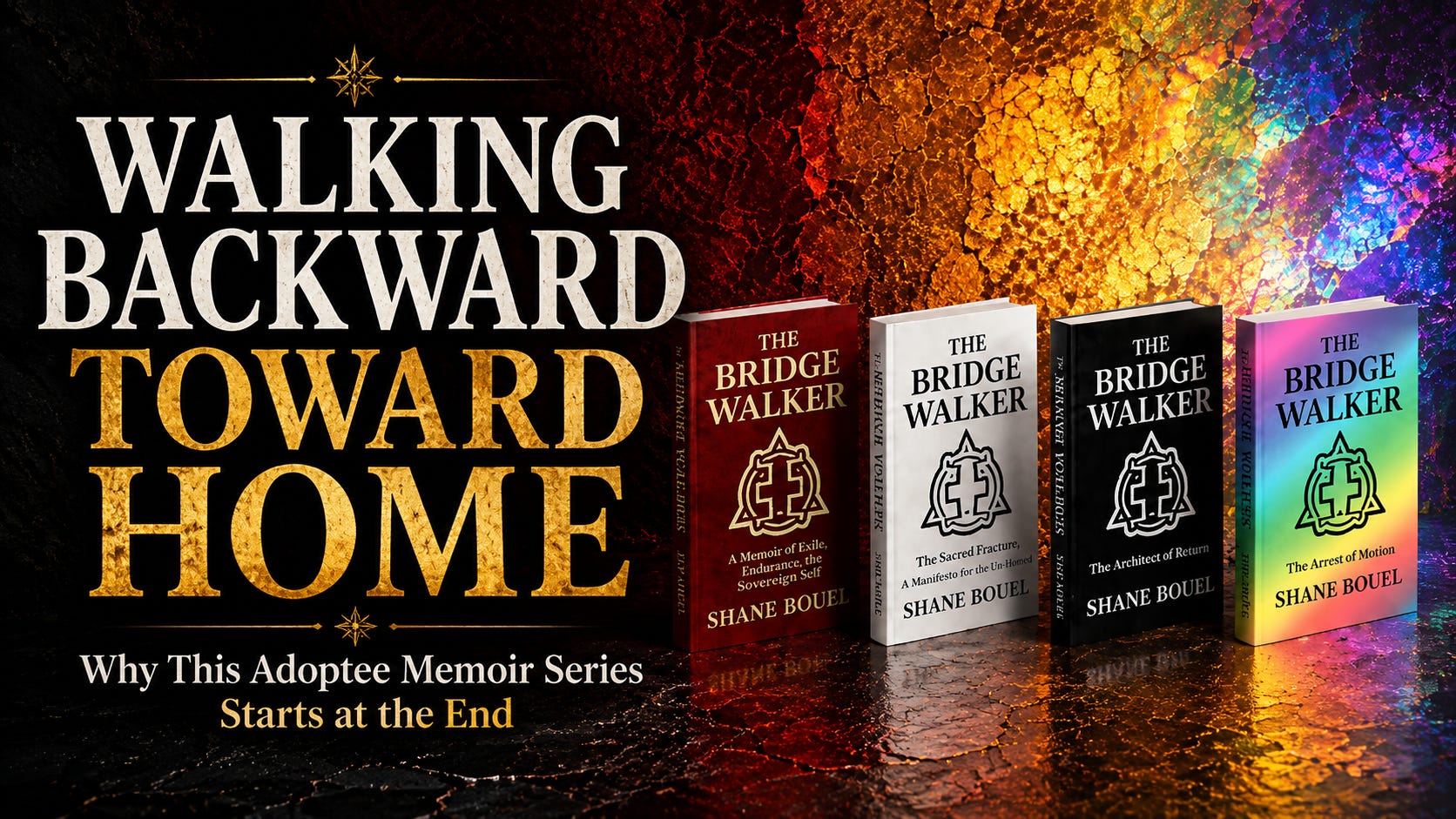
The series comprises four books, released in an order that mirrors the experience it describes. Book III — The Architect of Return — came first, because the blueprint precedes the confession. Book II — The Sacred Fracture — followed, the wound made visible. Book I — A Memoir of Exile, Endurance, and the Sovereign Self — arrived third, the origin finally named. And Book IV — The Arrest of Motion — closes the cycle in stillness.
This is not disorder. It is design — a structural metaphor for the adoptee life, in which the self must be built before it can be witnessed, and the wound must be named before the origin can be reclaimed.
“We inherit rupture before we ever know origin. The Bridge Walker books are written in the order life actually unfolds — from blueprint to wound to memory to rest.”
Each book stands alone. Together they form what Bouel calls a living theology of displacement — a fourfold descent and return that refuses the false comfort of resolution while insisting on the real possibility of sovereignty.
What This Series Is — and Is Not
The Bridge Walker Series occupies a register that has no ready shelf in the bookshop. It is not self-help. It makes no promises of healing and offers no prescriptions. It is not memoir in the conventional sense — not a linear account of a life recovered. It is not academic, though it draws on trauma theory, theology, and philosophy with a precision that earns its terms.
What it is: a forensic reckoning. A liturgical confrontation. Four books that treat the displaced soul not as a damaged subject in need of repair, but as a sovereign witness to its own experience — an experience that exposes the systems, fictions, and collective silences that created the wound in the first place.
Bouel writes from inside the experience of Australian forced adoption, but the series speaks to anyone who has lived the ontological dissonance of being told they are one thing while knowing themselves to be another. Anyone who has worn a name not their own, performed a belonging not genuinely theirs, or built an identity from survival rather than truth.
The Four Movements
Book III, The Architect of Return, arrives as manifesto. The reclaimed self speaks first — not as a survivor grateful to have escaped, but as a builder who has surveyed the wreckage and begun to lay foundations from truth. It is the philosophical frame that makes everything that follows legible.
Book II, The Sacred Fracture, descends into the wound itself. Here the fracture is not something to be overcome. It is a theology — the precise site where authentic selfhood becomes possible, because nothing false can survive it. The body becomes liturgy. The breakage, the blueprint.
Book I, A Memoir of Exile, Endurance, and the Sovereign Self, is where the philosophy becomes flesh. The lived account of Brisbane 1972, of adoption and its slow systemic violences, of the long work of reclaiming a self that the colony tried to overwrite. It is the most intimate of the four books, and because it arrives after the architecture has been laid, it can be read without the distortion of pity.
Book IV, The Arrest of Motion, is the final covenant. After construction, fracture, and excavation — stillness. Not as absence but as the highest form of sovereignty. The series ends not in triumph but in rest: the still soul, unhurried, no longer running from what is.
The Bridge Walker Series is complete. All four books are available now.


